EU Fuel Price Burden Index
This is the March 22–24, 2026 snapshot I built the map around. The prices below belong to that period; the demo isn't a live price feed.
Maybe I'm just pessimistic about Europe.
Or Estonia.
But it seems like a lot of the decisions are made in the interest of everyone else but the citizens. Diesel in Tallinn hit €2.169 yesterday — an all-time record, breaking the previous high from March 2022 at €2.059.
And what the shit is this?
And this.
And this.
And this.
And this bs.
So I thought... okay, fuel is expensive everywhere right now because of the Iran thing, but is it actually expensive here specifically? Like, relative to what people earn? And how much of it is the government's cut?
So here I am creating an index again. Not to prove anything, just to scratch my own itch.
I asked AI to pull the current fuel prices for all 27 EU member states from national sources, along with the tax breakdowns and average salaries. So here's a map with four layers you can toggle: petrol 95 price, diesel price, a fuel tax index (what share of the pump price is tax), and a fuel burden index (how much fuel costs relative to income). I don't know how accurate all of it is — the AI pulled from ERR, ADAC, OAMTC, RTE, and other national sources rather than the EC Weekly Oil Bulletin, which was apparently lagging behind real prices by €0.10-0.40 during this crisis.
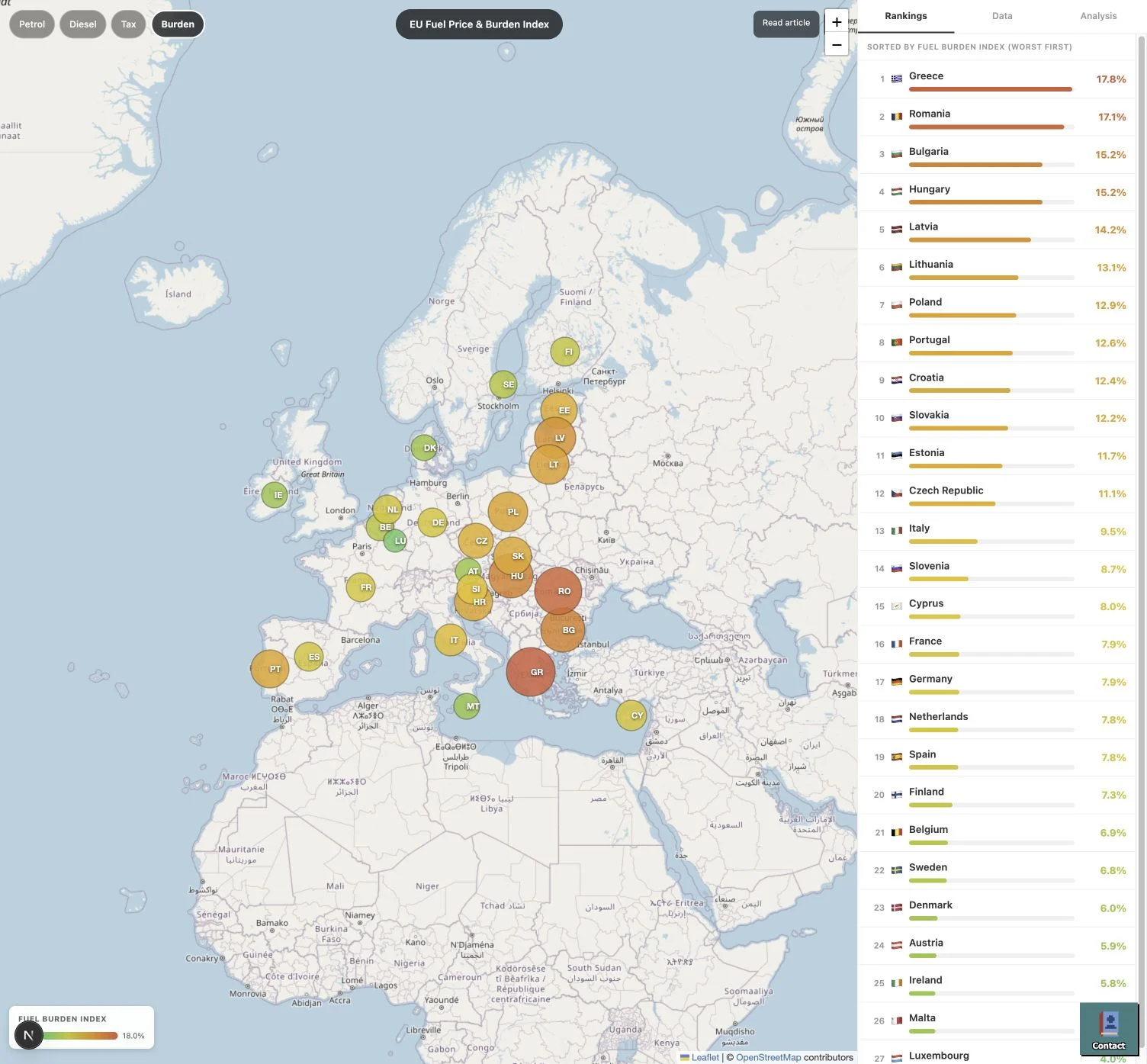
Open the interactive map. You can change the layer, inspect a country, and compare the rankings yourself.
The prices
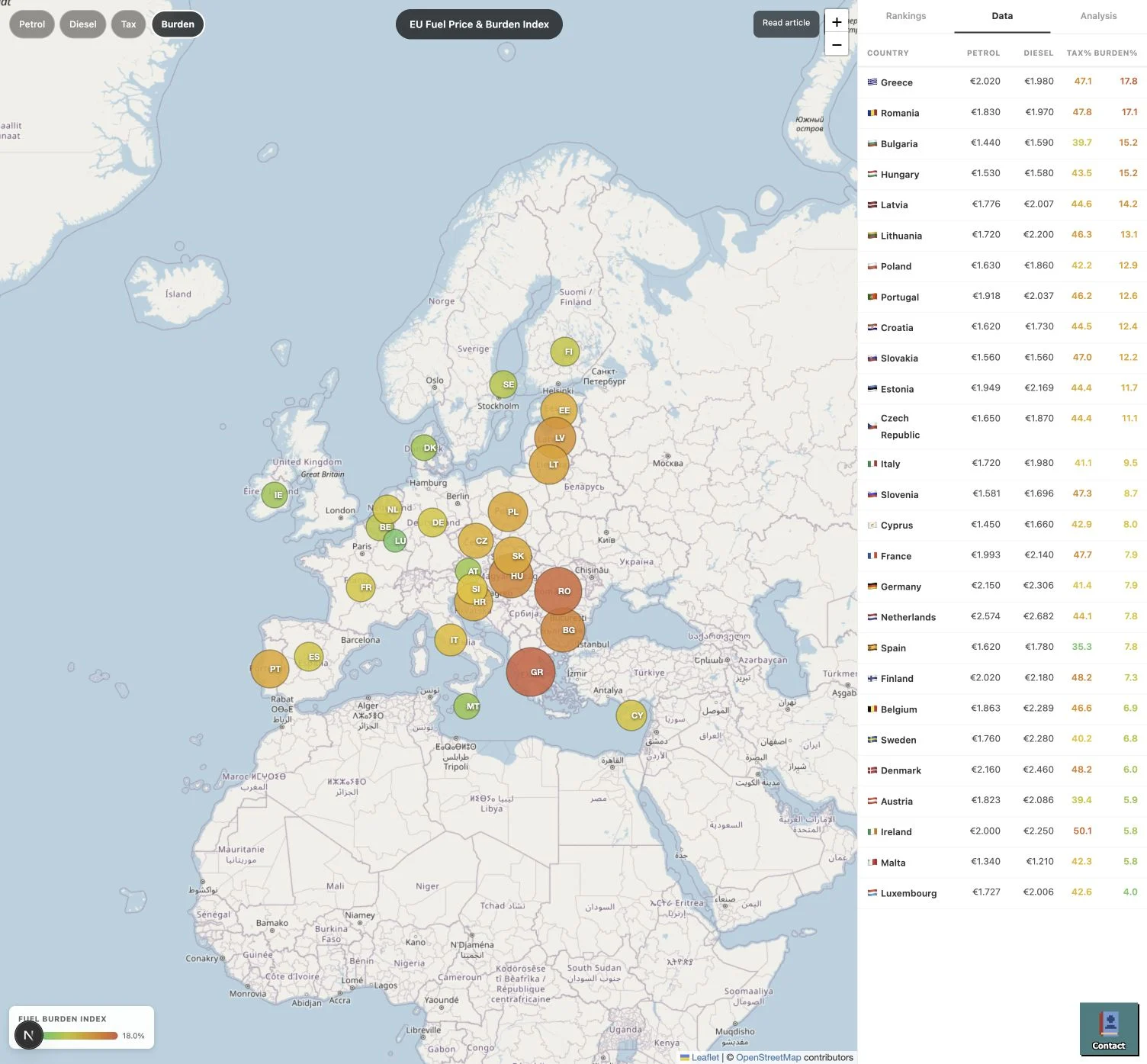
The Netherlands is the most expensive: €2.574 for petrol and €2.682 for diesel. Both all-time records. Denmark close behind at €2.46 diesel. Germany at €2.306.
Malta is the cheapest: €1.340 petrol, €1.210 diesel. Government-subsidized, prices frozen. Bulgaria €1.44/€1.59 and Cyprus ~€1.45/€1.66 are also on the low end.
The spread between Malta's diesel (€1.21) and the Netherlands' (€2.68) is €1.47 per liter.
Estonia: €1.949 petrol, €2.169 diesel.
Diesel is more expensive than petrol in 24 of 27 countries right now. Apparently diesel prices rose 1.5 to 2.5 times faster than petrol since the Strait of Hormuz closure — Sweden's diesel went up 42.4% in a month versus 23.2% for petrol.
The tax index
How much of what you pay at the pump is tax?
When you pay €2.169 for a liter of diesel in Estonia, €0.848 of that is tax (39.1% — €0.428 excise + €0.420 VAT). The remaining €1.321 is the actual product — crude oil, refining, transport, the station's margin. For every euro you spend on diesel, about 39 cents goes to the government.
Estonia's petrol at €1.949 has €0.968 in tax. That's 49.7% (basically half), so for every euro you spend on petrol, 50 cents goes to the government and 50 cents is the actual fuel.
Ireland has the highest combined index at 50.1% — when an Irish person pays €2.25 for a liter of diesel, €1.037 of that is tax. Finland and Denmark are both at 48.2%, and Spain is the lowest at 35.3% after their emergency VAT cut to 10%. The EU average sits at roughly 51% for petrol and 43% for diesel, and in 17 of 27 member states taxes make up the majority of the petrol price.
The burden index
The tax index shows how much of the price is tax. The burden index shows how much fuel costs you relative to what you actually take home — assuming 1,200 liters per year (roughly 20,000 km at 6L/100km, a normal commuter), expressed as a share of net annual salary (after income tax and social contributions). Using net rather than gross salary matters: Belgium's workers keep only 60% of their gross pay while Cyprus keeps 84%, so gross figures mask how affordable fuel really is.
Luxembourg comes in at about €2,240/year on a €56,336 net salary, which is 4.0%. Greece is at ~€2,400/year on a €13,519 net salary, or 17.8% — nearly one-fifth of take-home income before rent or food or anything else. In Greece, a liter of petrol costs 18.6 minutes of work; in Luxembourg, just 3.8 minutes. Estonia lands at ~€2,471/year on a €21,104 net salary, which works out to 11.7%.
The top 10 most burdened countries are Greece (17.8%), Romania (17.1%), Bulgaria (15.2%), Hungary (15.2%), Latvia (14.2%), Lithuania (13.1%), Poland (12.9%), Portugal (12.6%), Croatia (12.4%), and Slovakia (12.2%) — all Central-Eastern and Southern Europe.
Tax vs. burden
Ireland has the highest tax share at 50.1% (over a euro per liter), but fuel burden is only 5.8% because the net salary is €44,445. Bulgaria has one of the lowest tax shares at 39.7% (only €0.595 per liter in tax), but fuel burden is 15.2% because the net salary is €11,940. The Netherlands has the EU's highest petrol excise at €0.845/L and the most expensive pump prices, yet burden is 7.8%.
The three countries where fuel costs the most relative to take-home income — Greece, Romania, Bulgaria — all have below-average tax shares. What you actually earn matters more than tax rates for how much fuel costs you.
Data
Prices from national sources, March 22-24, 2026. Net salary derived from Eurostat gross (2024) using OECD Taxing Wages 2025 effective tax rates. Tax rates from Tax Foundation / EC (January 1, 2026), adjusted for emergency measures.
Some country prices are estimates based on the March 16 baseline plus weekly growth rates, so they carry some uncertainty. I don't know how accurate all of this is — it's what came out of a few AI prompts and I haven't manually verified every number. Take it for what it is.