Paper Money Catalogue (for dad)
My dad collects banknotes. I built him a website for them.
That's the origin story. No gap in the market, no startup pitch. He had a collection and needed a proper way to organize and show it online, and I could make that happen.
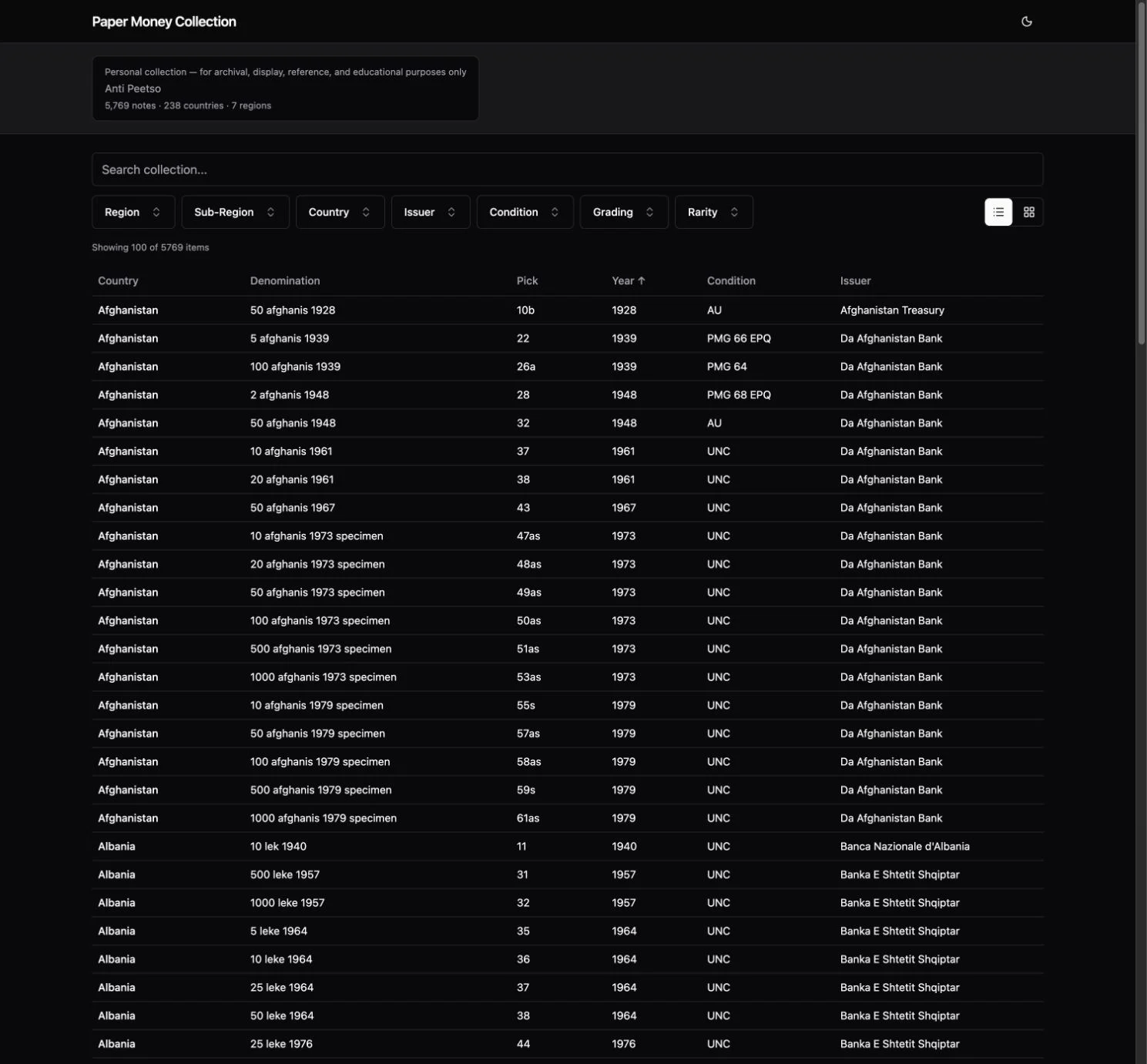
But when I say "a collection," I mean thousands of notes. The public catalogue had 5,769 entries when I took these screenshots. So this is a little more involved than putting a few pictures on a page.
Making the collection browsable
A collection has its own logic. If you don't collect banknotes, you might look at two of them and think they're basically the same thing. The person collecting them is looking at the year, the issuer, the condition, the variation, and the reference that identifies which note it actually is.
So the interface has to respect those distinctions. There's text search, then filters for region, country, issuer, condition, grading, and rarity. The table puts the identifying details beside each other so you can compare entries without opening every one.
I like this kind of work. You have to understand enough about someone else's subject to make a useful tool for them. A generic image gallery would technically display the collection, but it would leave out most of what makes it a collection in the first place.
Then you actually look at the money
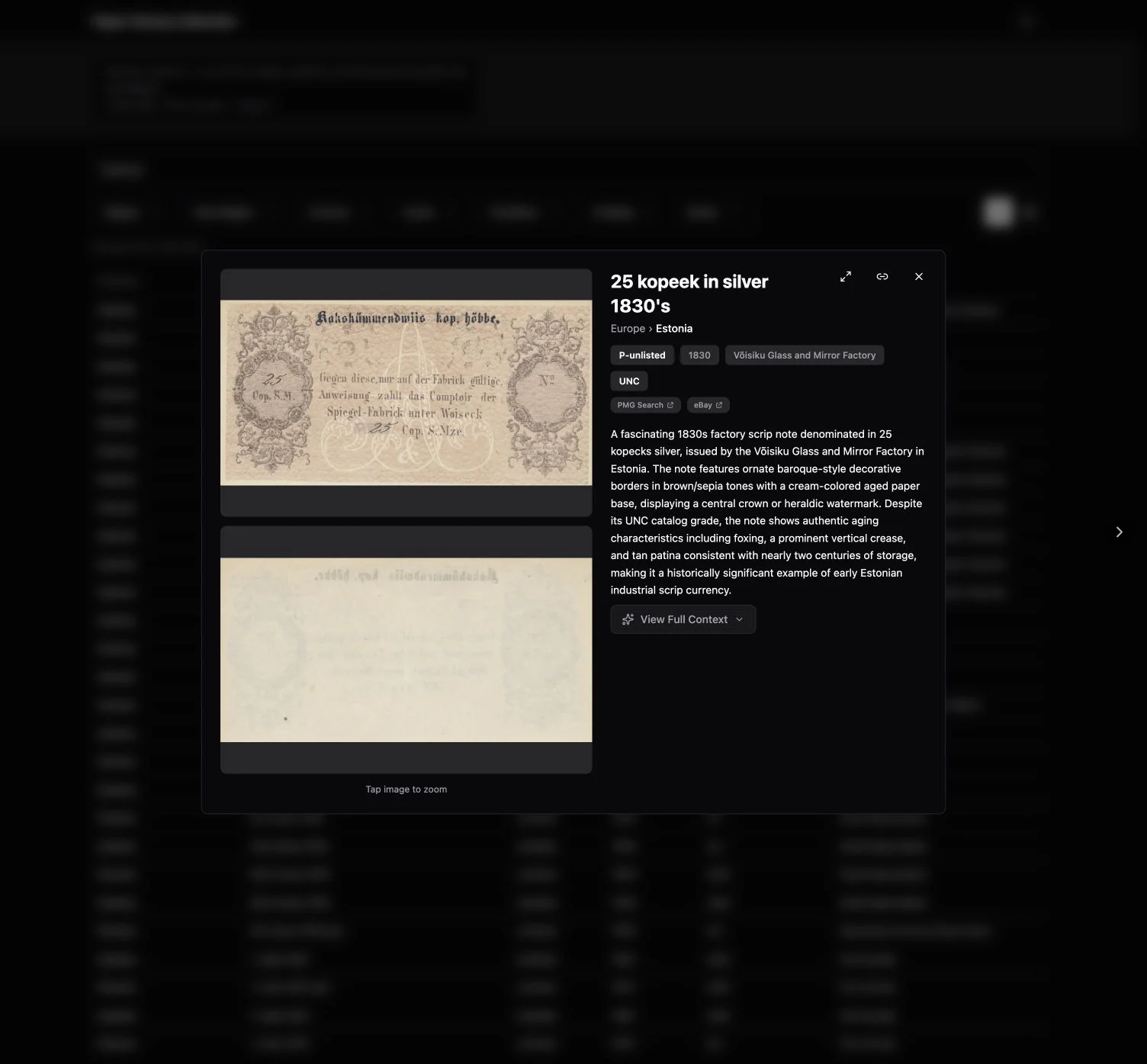
Open a note and you get the images alongside its details. You can enlarge the scans, open the full page, or copy a link to that particular note. That last part is useful for a very ordinary reason: if you want to show someone a thing in your collection, you should be able to send them that thing.
The site also provides links out to reference searches. The catalogue is an archive for browsing and learning about the collection; it isn't pretending to be a shop just because the objects happen to be money.
And some of the objects are interesting even if you know absolutely nothing about collecting. The one above came from a glass and mirror factory. A row that initially looks like "country, year, denomination" suddenly has a whole other history behind it.
I don't need to be the expert on that history. My dad is the collector. My job was to make his collection easier to explore.
A good enough reason to build something
A lot of the tools on this site came from me being annoyed at something. This one's simpler. Someone in my family cares about a subject, and I could build something useful around it.
It doesn't need to become anything bigger than that.