How to Choose the Right Supplement?
This is the first article in my upcoming supplement series, where I want to share practical knowledge about supplements from the perspective of a human guinea pig who's tried everything on himself.
The purpose of a supplement is to give you micronutrients that you might not be getting enough of from regular food, for whatever reason. Supplements can be vitamins, minerals, amino acids, fatty acids, superfoods, over-the-counter remedies, or other potentially beneficial substances that come in tablets, capsules, liquids, powders, or other forms.
Going forward I'm going to assume my smart readers already know all of that, and that they're also aware supplements aren't a replacement for a balanced, healthy diet.
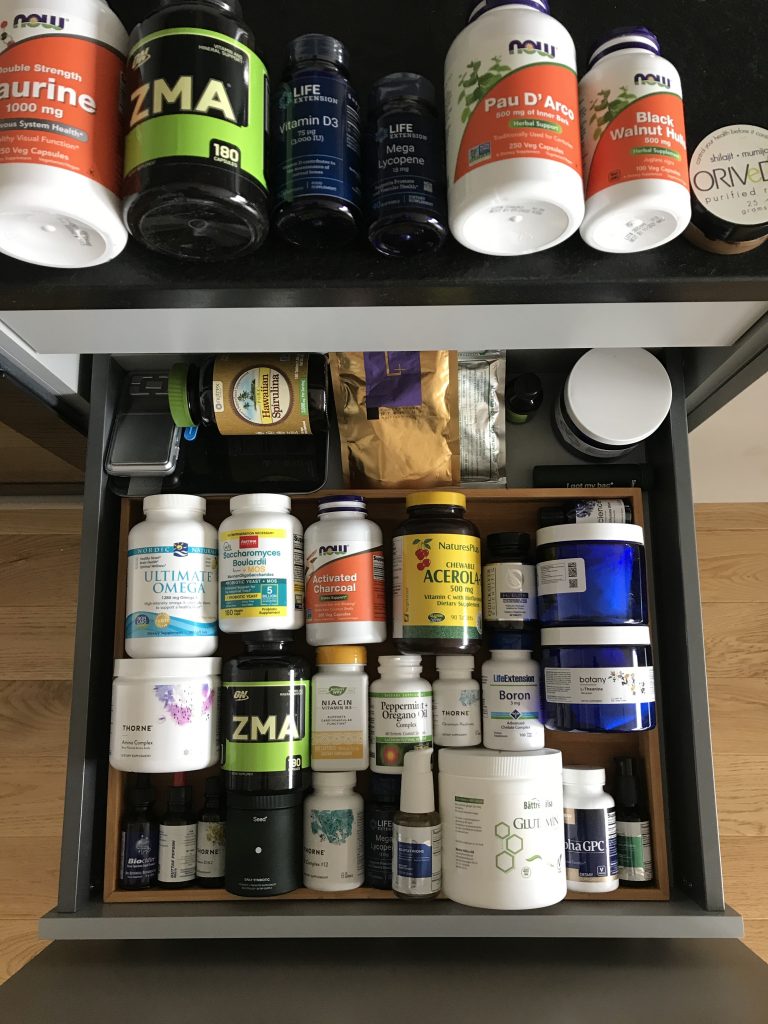
My collection, not everything is in the picture.
My fascination with supplements is an expensive hobby, but I treat it as an investment in my health and productivity. And if I don't try everything on myself, how am I supposed to know what actually works?
Over the years I've learned to find my way through the corrupt supplement industry and discovered different tactics for telling a quality product from garbage.
I also understand why, even among professionals, opinions on supplements split into two camps.
But my general take is that the heated opposition comes from a couple of fundamental misunderstandings and the bad reputation of an unregulated industry.
I think a good place to start is to talk about that messy industry.
The Wild West
Since supplements are mostly an unregulated market, the situation is often compared to the Wild West. What benefits a product can claim in advertising is regulated, but the products themselves have basically zero quality control or oversight.
Because industrial-scale production is way more efficient and cheaper, the vast majority of supplements and vitamins produced today are synthetic.
Even in the supply chain of the most basic vitamin, from raw material to pharmacy shelf, there are up to 20 links. Unless a company has enforced extremely strict quality control methods from raw material inspection all the way to the last link in the supply chain (including transport to the pharmacy and storage conditions there), it's likely that the company selling the product doesn't even know where all their raw materials come from. Usually the cheapest raw material comes from China, which is a black hole from a regulatory standpoint.
But how do you know if a given company has an extremely strict quality control process?
They'd tell you. That claim would definitely be one of their marketing trump cards.
Since the market is unregulated, in most countries producers aren't even required to test their raw materials.(1, 2) Even when they do, for vitamins the actual bioactive ingredient needed is so tiny that most of the tablet is made up of other stuff mixed in during production — binders and fillers.
These can be inactive fillers like cellulose, sugar, rice flour, and coloring & flavoring agents. It all depends on the final product of course, but this is how most synthetic vitamins are made. Then all the basically identical vitamins get packaged, branded, and sent off to store and pharmacy shelves.
If a company wants to claim their products are domestic, the reality is that none of the raw materials actually have to originate from Estonia — and the same goes for most other countries. Also, if you want to claim your product is natural, most regulators haven't even defined what "natural" means. So your product packaging can say it's "natural" while containing only synthetic ingredients.
Plenty of studies have been conducted where lab tests found that supplements don't contain the promised substances. It's also very common for tested products to contain advertised ingredients in wrong amounts, packed with fillers, some of which are completely unnecessary or outright illegal.(3, 4, 5)
Business models vary, but there's a very high chance the company on the label isn't actually the one producing the raw materials. For synthetic substances you could even say that no brand has actually manufactured their own product. Supplement companies with a wide product range simply buy the necessary raw materials and mix & package them as they see fit. Often they don't even do that — they use contract manufacturing. Most manufacturers offer their products unbranded, and you and I can slap our own label on them and sell them without any quality control whatsoever. And finding manufacturers is dead simple. On Alibaba.com you can order any substance with your own logo for next to nothing.
Unfortunately the vast majority of products on the market have been made through these worse variants, and neither pharmacies nor health food stores do background checks on the brands they carry.
(and if they did, that would again be their marketing trump card)
In the sports world it's not uncommon for professional athletes to test positive for doping because a multivitamin from the pharmacy shelf or a protein powder from a shopping center was contaminated with banned substances produced on the same lines.(6, 7, 8)
Even responsible producers and eco-friendly paleo organic vegan superfoods aren't always safe. Often the risk is actually higher with those. Since anyone can start producing and selling supplements and superfoods, dangerous mistakes happen out of pure inexperience, not malice. This is where the flaws of an unregulated market really show. Supplement brand owners have described cases in their business where they wanted manufacturers to use a specific high-quality ingredient, but it later turned out a cheap substitute had been secretly used instead. I'm aware of one specific case where the manufacturer ordered the correct ingredient for the reseller's inspection, but before starting production sent it back and swapped it for a cheap substitute sourced from China. When the problem surfaced later, the manufacturer just pointed to the original purchase invoice and denied responsibility.
So in the worst case, the supplement seller themselves has no clue what their product actually contains. All of this makes taking supplements risky, and on the whole it could do your health more harm than good.
Now maybe you understand why it's likely that you're consuming low-quality products.
And you'd be wrong to think that just because you don't take vitamins, all of this is irrelevant to you. Even if you're not swallowing supplements in tablet form, you're probably eating synthetic vitamins through other foods. The culprits are all sorts of fortified foods: cereals, bars, margarine, milk, juices, breads, sports drinks, etc. Everything I just said about quality applies to those too.
In Defense of Supplements
The Estonian National Institute for Health Development's website toitumine.ee writes the following about supplements:
"A misconception has developed that supplements form a natural part of our daily life. People believe that a healthy lifestyle isn't possible without additional vitamins and minerals. Siret Dreyersdorff, chief specialist of the Ministry of Agriculture's food general requirements bureau, explains in the Maablog what you should know before buying and consuming supplements.
Supplements are often consumed to compensate for an unhealthy diet, which in turn is blamed on a busy lifestyle. This way, consuming supplements can quickly become a habit. However, supplements don't replace healthy eating and their purpose is only to complement regular food. Supplements can contain vitamins, minerals, amino acids, fiber, pre- and probiotics, fatty acids, plant and herbal extracts."
I completely disagree with the claim that "supplements are often consumed to compensate for an unhealthy diet." My impression is actually the opposite — people who eat unhealthily don't bother with supplements. It's just not their priority. I think it's more the health-conscious person who takes supplements, to complement an already healthy diet. Among the general public, the more common view seems to be that supplements are a pointless expense.
Since you're already reading this, I'd bet that you, like me, work out, eat enough vegetables, prioritize good sleep, drink enough clean water, and spend as much time outside in the sun as possible. You're an intelligent, well-informed person when it comes to health topics, someone who's done the work on themselves and takes pride in their passion for healthy living, nutrition, science, and sports. But if all that's true, then why would you even want to take supplements? Doesn't a healthy and clean lifestyle give you enough vitamins, minerals, and antioxidants?
I totally get it: the supplement space is complicated (especially after reading the previous chapter), swallowing pills is annoying, and now it turns out they might even be dangerous. Why bother at all?
Let me offer a slightly different perspective.
Our modern, post-industrial lifestyle, polluted with toxins, demands more nutrients than regular food can provide.
It's been repeatedly proven that the constant stressors of modern life — from heavy metal pollution to synthetic chemicals and sensory overload — raise your body's need for vitamins, minerals, and antioxidants.(9) Your body uses these nutrients to detox and to prevent the formation of free radicals that damage DNA.
There's an interesting study that helps frame this concept — it tracked how chess grandmasters burn up to 6,000 kcal per day from brain work alone during tournaments. That's three times the average person's daily energy needs — even more than most professional athletes.(10)
All this means that even if you eat healthy, nutrient-rich food, it's likely you're not getting all the nutrients your body actually needs.
And "healthy food" is a very tricky concept in itself. Most people consider their diet healthy, yet regularly consume inedible rancid oils and many times the recommended amount of sugar.
It seems reasonable to say that all necessary nutrients should come from food. That instead of taking supplements we should just eat more. But the benefits of caloric restriction are strongly established in the science. Because on top of all the associated benefits, caloric restriction is also the only scientifically proven way to promote longevity, across all organisms.(11, 12) This extends to intermittent fasting as well.(13)
And here again is the importance of supplements: they allow you to get enough of the nutrients you need for life while also pursuing health strategies like intermittent fasting or caloric restriction.
The claim that supplements don't form a natural part of our daily life is also wrong. First of all, how do you define a natural part? Based on ancestral behavior?
Humans have used supplements throughout their long history. The fact that our ancestors' substances weren't in tablet form doesn't mean they weren't supplements. Ancient supplements were all kinds of roots, seeds, leaves, and concentrated oils. Also, since our ancestors were more connected to nature than we are, they encountered more dirt. That had its downsides for sure, but that same dirt contained various beneficial microbes and probiotic organisms that simply don't exist in today's sterile society.(14, 15, 16, 17, 18) Instead, we now consume different probiotics in tablet form.
All sorts of animals, from insects to chimpanzees, consume medicinal plants as supplements just like humans do.(19, 20) For example, certain species that get infected with parasites deliberately eat poisonous plants to cure themselves. Ants fight microbes and bacteria by carrying pine resin into their nests. Several other animal species eat clay to combat stomach irritation.
At the end of the day, consuming vitamins, minerals, and also nootropic and psychedelic substances is a historically respected, natural way to enhance your own body and mind. While many would argue that your brain should function fine without all of this, assessing it from the combined perspective of ancestral wisdom and modern science, I would, with all due respect, have to disagree.
How to Spot Quality?
Identifying quality supplements isn't a complicated process, though it is a bit tedious.
First, the product you want to buy needs to be bioactive to guarantee any therapeutic potential.
What else you should look for:
- What the product contains (bioactive ingredients you actually need, the things that make the product useful)
- What the product doesn't contain (heavy metals, fillers, questionable additives)
This information is very easy for a manufacturer to find out. Objective third-party testing isn't expensive or time-consuming.
Unfortunately many sellers prefer to keep things vague, don't disclose details, and don't test their products. This means consumers have no idea what they're buying and whether the product is even safe or not.
The golden rule is: trust the label, not the packaging.
For marketing purposes, sellers prefer to highlight buzzwords on the packaging like organic or that the product contains only natural ingredients instead of objective information. As we discussed, these are misleading claims. Objective properties are shown on the nutritional label, not on the website, the packaging design, or a brochure.
Organic doesn't necessarily mean quality. Potential related risks, like contaminants, are generally covered by third-party testing.
If a seller lacks the necessary details and objective testing, it means their products are of questionable value and you'd be smarter to avoid them. No seller in their right mind would leave good test results unpublished.
Don't be fooled by a low price. A worthwhile product requires strict quality control and strict processing procedures. The kind that low-priced products can't afford. Once you start paying attention, you might notice that low-quality products lack clear specifications and/or third-party test results.
When in doubt, ask.
Send the company an email and find out:
- What quality control standards do they follow?
- How many steps are in their supply chain?
- What substances do they use in their manufacturing process?
- How do they test their product's effectiveness?
- Have they conducted third-party testing?
If they can't answer your questions, or give you vague answers like:
"We are currently in the process of obtaining ISO22000 certification for our production and all the questions you've raised are on our agenda and being addressed. Raw material quality is important to us and we work on these topics daily."
Then just don't use their products. Not worth risking your health over.
Since supplements and the whole market are very interesting to me, I've created a Recommendations section on this same site, where I've put together my personally validated product selection. If you decide to purchase products through my links, I get a small commission on each sale. But the price doesn't change for you — sometimes you might even get a discount.
If I recommend a product, you can be sure that I've used it myself, validated it, and that I genuinely recommend it.
My priority is to provide valuable information to support the positive development of your health, well-being, performance, and longevity, and I only share products and information that serve that purpose.
References
- https://www.vitamaniathemovie.com/an-industry-perspective-on-how-australia-regulates-vitamins/
- https://www.vitamaniathemovie.com/australian-regulation-of-vitamins-and-related-products/
- https://www.health.harvard.edu/blog/whats-in-your-supplements-2019021515946
- https://www.ncbi.nlm.nih.gov/pmc/articles/PMC4330859/
- https://www.nejm.org/doi/full/10.1056/NEJMsa1504267
- https://www.ncbi.nlm.nih.gov/pubmed/16195040
- https://www.ukad.org.uk/athletes/managing-supplement-risks
- https://www.tandfonline.com/doi/abs/10.1080/15563650.2017.1398328
- No single definitive study here, a collection of relevant references https://docs.google.com/document/d/1tgXKe8oGDICETgHTs48qy6FMdOQTtK3HwT10ce2uN-Q/edit?usp=sharing
- https://www.cnbc.com/2019/09/22/chess-grandmasters-lose-weight-burn-calories-during-games.html
- https://www.nature.com/articles/s41598-018-24146-z
- https://www.sciencedirect.com/topics/biochemistry-genetics-and-molecular-biology/caloric-restriction
- https://www.nejm.org/doi/pdf/10.1056/NEJMra1905136
- https://en.wikipedia.org/wiki/Human_interactions_with_microbes
- https://www.ncbi.nlm.nih.gov/pmc/articles/PMC4312737/
- https://www.ncbi.nlm.nih.gov/pmc/articles/PMC5287379/
- https://journals.plos.org/plosbiology/article?id=10.1371/journal.pbio.1002020
- https://www.theguardian.com/news/2018/mar/26/the-human-microbiome-why-our-microbes-could-be-key-to-our-health
- https://www.pnas.org/content/111/49/17339
- https://en.wikipedia.org/wiki/Zoopharmacognosy