Are You Breathing Correctly?
I was 13 years old when my cousin and I, along with some of his friends in Tartu, were making a little short film. Playing a big role and full of excitement, I scarfed down dinner, hopped on my bike and raced through a small patch of forest toward the filming spot. What I didn't see in the dark was a tree trunk that the village drunks had chopped down during the day, still lying right across the forest path.
I went over the handlebars, face-first into the dirt — concussion and a broken nose.
10 years later my nasal septum was still crooked, which meant I'd been breathing mostly through my mouth for at least a decade.
So what's the problem?
The surprising role your nose plays in your overall health
While you can breathe through your mouth, it's far from ideal.
Your nose is a big deal and it does way more than just sit there looking pretty on your face. Nasal breathing is a prerequisite for living a quality life and breathing correctly has a staggering number of health benefits.
Most of us know that breathing through the nose filters, warms and humidifies air, making it more accessible to the body. But you might be surprised by the connections between your nose and health issues like erectile dysfunction, hormonal imbalances, blood pressure problems and digestion. On top of that, the nose is connected to women's menstrual cycles, it regulates heart rhythm, opens blood vessels in your toes, stores memories — and you can even estimate someone's risk of developing asthma by looking at the density of their nose hair.
Air inhaled through the nose first encounters tiny hair-like structures called cilia. The cilia's job is to filter, moisten, warm and cool the air before it reaches the lungs. It's estimated that cilia protect us from more than 20 billion foreign particles every single day.
But that's just the beginning.
Proper nasal breathing lowers high blood pressure and stress, and keeps you from overexerting yourself during exercise. It amplifies your sense of smell, improves oxygen absorption in the lungs and boosts the production of nitric oxide in the sinuses — which improves circulation and fights harmful bacteria & viruses.
Breathing through your nose (both in and out) allows you to take deeper, fuller breaths. The process of absorbing oxygen doesn't happen instantly in the body. Nasal breathing is slower than mouth breathing, which gives your lungs more time to extract oxygen from the air compared to mouth breathing. It might feel like you're getting more air in faster through your mouth, but the body doesn't extract as much oxygen from it and doesn't make it as available as it does with nasal breathing.
Nasal breathing also stimulates the lower parts of your lungs, which contain a large number of parasympathetic nerve receptors — these are associated with calming effects on both body and mind. Mouth and chest breathing, on the other hand, uses the upper parts of the lungs, which are linked to panting, hyperventilation and stimulation of sympathetic nervous system receptors — the ones tied to the fight-or-flight stress response.
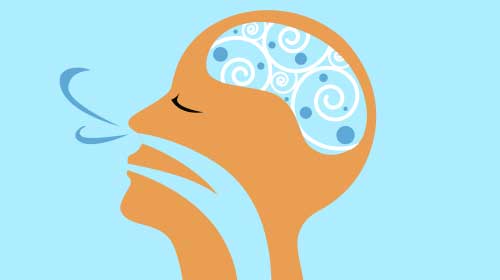
Breathing correctly is pretty calming
Again, even though mouth breathing and panting gives you the impression that you're getting more oxygen into your body, the actual effect is the opposite. Oxygen levels in the body are influenced by carbon dioxide. The more carbon dioxide in your body, the more oxygen your body can actually absorb. This is called the Bohr effect. Panting, because you're exhaling carbon dioxide, actually reduces oxygen levels in the body. If you want to get more oxygen into your body — during exercise, for example — you need to breathe through your nose and slower, not faster.
Because of this paradox, most people breathe too much — a phenomenon called overbreathing. And learning to breathe correctly is considered one of the best treatments for allergies and modern chronic & autoimmune diseases. Nasal breathing is the first step toward fixing your breathing pattern.
Dr. Weston A. Price was a well-known and respected American scientist. His goal was to figure out how nutrition affects human physiological growth and development, and in the 1930s he traveled the world studying indigenous peoples. At that time, many of these indigenous communities had never come into contact with the Western world (or our highly processed, nutrient-depleted foods).
For the most part, indigenous peoples who consumed nutrient-rich diets like their ancestors had good-looking faces with wide facial structures, broad dental arches, remarkably straight teeth, and zero tooth decay.
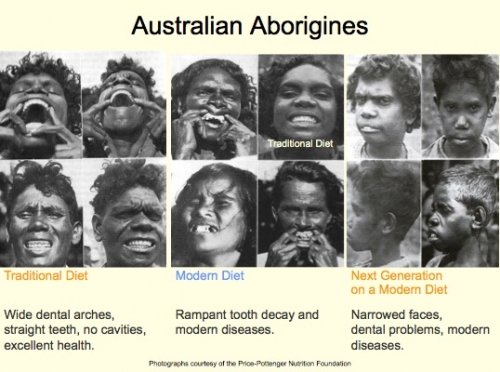
Changes over 2 generations
In later years, when those same communities started consuming wheat flour, sugar and nutrient-poor Western foods, within a single generation their faces grew narrower, their dental arches became irregular, teeth grew crooked, and tooth decay ran rampant.
Price concluded that these developmental issues were caused by low nutrient availability (and absorption). He also believed that Western dietary patterns promote allergies and respiratory blockages. This in turn causes mouth breathing, which leads to poor tongue posture, and that results in facial maldevelopment.
[2026 update: Price's observations linking nutrient-dense traditional diets to broad facial development are well-documented across multiple cultures. Chris Masterjohn's identification of Price's "Activator X" as vitamin K2 (2007) provided a biochemical mechanism: K2 directs calcium into bones and teeth, supporting maxillary development. Modern research suggests facial development is influenced by multiple complementary factors: nutrition (particularly fat-soluble vitamins A, D, and K2), mechanical loading from chewing harder foods, and nasal breathing patterns. These are complementary rather than competing explanations.]
In the 1980s, Egil P. Harvold carried out a disturbing experiment. He placed silicone plugs deep into the nasal passages of rhesus monkeys, forcing them to adapt to permanent mouth breathing.
Over the following 6 months, Harvold measured the animals' dental arches, jaw angles, facial length and everything else he could. In just 6 months, the monkeys with blocked noses developed the same narrowing of dental arches, crooked teeth and open-mouth posture that's so common in humans today. Harvold repeated these experiments and kept the animals' noses blocked for up to 2 years, and things only got progressively worse.
These photos clearly show what's happening around us in our own species: just a few months is enough for faces to grow longer and jaws to become lazy and misshapen.
Nasal breathing allows for normal craniofacial development, temporomandibular joint function, head positioning and overall facial symmetry.
The best and most natural way is to breathe through your nose. Many children (and adults) who have autoimmune issues like asthma, nasal congestion, or produce excessive mucus tend to breathe through their mouths as a result. Unfortunately, children who develop mouth breathing habits develop asymmetric faces and poor jaw & teeth alignment.
Turns out, mouth breathing physically changes us and deforms the airways. It reduces pressure in the mouth, which causes soft tissues to loosen and collapse inward, reducing space. Mouth breathing can cause the face to grow long and narrow, which inhibits full development of the jaw — and as a result the jaw shifts backward from its ideal position. This in turn, among other problems, reduces airway openness and makes nasal breathing even harder.
Mouth breathing causes more mouth breathing.
Nasal breathing has the exact opposite effect — it gradually trains the relevant muscles, making nasal breathing progressively easier over time.
The nose, mouth, airways and lungs aren't separate autonomous body parts — the body is a system, and whatever is going on with your nose affects all of it.
Sleeping with your mouth open only deepens these problems. When we lay our heads on the pillow, gravity pulls the soft tissues in the throat and the tongue downward, further closing off your airways. Once your body gets used to this position, snoring and sleep apnea become your new normal.
But all of this is changeable. By improving your breathing, you can reap the benefits of all the positive effects of nasal breathing — and even change your facial symmetry.
Mouth breathing makes you dumber
There's a bunch of anecdotal stories out there about people who, after fixing nasal obstructions, experienced improvements in learning ability, memory and even IQ. I can relate to this from personal experience.
A recent Japanese study showed that mice with blocked nostrils developed fewer brain cells as a result of mouth breathing, and it took them twice as long to solve tasks compared to the nasal-breathing control group. Another Japanese study from 2013 in humans found that mouth breathing disrupted oxygen transport to the prefrontal cortex — the brain region associated with attention disorders.
Nasal breathing is also strongly linked to quality restorative sleep.
If for whatever reason nasal breathing doesn't happen during sleep — whether due to bad habits or a health condition — sleep-disordered breathing can develop, which directly affects children's (and adults') growth, development, learning ability, behavior, and a lot more.

Your mouth should probably be shut most of the time
Picture in your head a bratty kid with a runny nose, mouth hanging open and a dull look in their eyes. Unfortunately that's not just a stereotype — it's reality. But it's not the kid's fault.
We need to learn to breathe better
Even the ancient Chinese knew all of this.
In Taoism, a mouth-drawn breath was described as 'Ni Ch'na', meaning an adverse breath, and the practice was warned against.
The medical breakthroughs of the last century have saved countless lives and multiplied quality of life around the world.
But dozens — hundreds — of top doctors at Harvard, Stanford, Johns Hopkins and other institutions keep saying the same thing. Modern medicine, in their words, is remarkably effective for emergency cut-open-and-sew-back-up situations, but falls short when it comes to treating milder chronic and systemic conditions — like asthma, headaches, stress and autoimmune diseases, which is what the majority of the modern population actually struggles with.
Experts have explained, in so many words and in so many different ways, that a middle-aged man suffering from work-related stress, irritable bowel syndrome, depression and occasional tingling in his fingers doesn't get the same attention from doctors and the medical system as a patient with kidney failure. He'll probably just get prescribed blood pressure meds and antidepressants and be sent on his way. The role of the modern doctor is to put out fires, not blow away the smoke.
Nobody's happy with this arrangement: doctors are frustrated that they don't have the time or support to prevent or treat milder chronic issues, and at the same time patients are given the impression that their problems weren't serious enough to seek attention for.
That's one reason why it seems like so many people — and so many medical scientists — have come full circle back to breathing. Like all Eastern medicine traditions, breathing techniques work best as prevention. A way to maintain balance in the body so that minor issues don't develop into serious health problems. And even when we do lose that balance from time to time, it can often be restored through breathing.
Nine out of ten of the deadliest diseases — diabetes, heart disease, stroke — are caused by the food we eat, the water we drink, the houses we live in and the offices we work in. These are diseases we've created ourselves.
While some of us may have a genetic predisposition toward one disease or another, that doesn't mean getting those diseases is predetermined. Genes can be switched on and off, and that's influenced by environment. Improving nutrition, exercising and removing environmental toxins & stressors from your home and workplace has a very strong lasting impact on preventing and treating most modern chronic diseases.
Correct breathing plays a big role in this as well.
The famous physician and founder of integrative medicine, Andrew Weil, wrote that if he were limited to giving just one piece of health advice, it would simply be to learn to breathe better.
How to breathe correctly?
There are a ton of ways and exercises to learn proper breathing, depending on your goal.
Based on ancient teachings, yogic traditions, experienced breathing practitioners and meditators, it seems like 5.5 seconds in and 5.5 seconds out is the rhythm you want to develop.
You also need to breathe with your belly.
But obviously it's not as simple as just switching your subconscious breathing pattern right this second. Luckily there are plenty of exercises to get you there — here are a few that I practice regularly.
4-7-8 Breathing
This technique was popularized by Andrew Weil, mentioned earlier, and it puts your body into a deeply relaxed state. In this technique you use your mouth for exhaling.
- Take a deep breath in, then exhale through your mouth with a whooshing sound
- Close your mouth and quietly inhale through your nose while mentally counting to 4
- Hold your breath for 7 seconds
- Exhale through your mouth, with a whooshing sound, for 8 seconds
- Repeat this cycle for at least 4 breaths. The longer, the better
Weil has also uploaded a tutorial video to YouTube
Box Breathing
US Navy SEALs use this technique to stay calm and focused under pressure. It's dead simple.
- Breathe in for 4 seconds
- Hold your breath for 4 seconds
- Breathe out for 4 seconds
- Hold your breath for 4 seconds
Longer exhales trigger stronger parasympathetic responses. A variation of box breathing for deeper relaxation, which is especially effective before bed or for winding down after a workout:
- Breathe in for 4 seconds
- Hold your breath for 4 seconds
- Breathe out for 6 seconds
- Hold your breath for 2 seconds
Repeat for at least 6 cycles — the longer, the better.
Breath-hold walking
This technique is used to raise carbon dioxide levels in the body, which in turn improves circulation. It's not exactly fun, but it has a lot of benefits.
- Find a park with grass, a beach, or any other area with soft ground
- Exhale everything from your lungs and then start walking slowly, counting each step
- When you feel a strong air hunger, stop counting but don't stop walking — take a few very calm breaths through your nose
- Breathe normally for about a minute
- Repeat the cycle
The more you practice this technique, the more steps you'll be able to take. In James Nestor's book Breath, where I found this technique, he mentions that Anders Olsson's personal record is 130 steps and his own is only a third of that.
NB! If your blood pressure is high, it's better to work on improving that condition with other breathing exercises first before you start practicing this one.
I also recently found the Breathwrk mobile app, which makes practice really convenient thanks to audio cues.
Surprisingly, at the same time I was writing about breathing, other health enthusiasts and bloggers were writing about it too — without any of us knowing. I highly recommend checking out Siim Mesipuu's latest article "Suu on söömiseks ning nina hingamiseks" (in Estonian), which is written from a different angle and complements this article really well.
Further reading
- Joe Rogan Experience #1506 - James Nestor
- Biohack Your Breath With Nose "Boners," Carbon Dioxide Inhalation, Tibetan Longevity Stretches & Much More: How To Unlock The New Science Of A Lost Art.
- James Nestor "Breath: The New Science of a Lost Art"
- Patrick G McKeown "The Oxygen Advantage: The Simple, Scientifically Proven Breathing Techniques for a Healthier, Slimmer, Faster, and Fitter You"
- Three Breathing Exercises And Techniques
- Potent Breathwork Tactics From A Navy SEAL Commander, Staring Down Your Wolf, Operating Calmly Under Stress & More With Mark Divine.
- The Ultimate Breathwork Ninja Guide: How To Banish Stress & Kiss High Cortisol Goodbye